

Hypermobility
%20(3).png?width=1280&height=720&name=Osteoporosis%20Management%20(header)%20(3).png)

Osteoporosis is often described as a “silent” condition because many people do not realise they have it until a fracture occurs. In some cases, this can happen after a relatively minor fall. While this can be unexpected, there are well-established strategies that can reduce fracture risk and improve bone strength over time. Management involves a combination of lifestyle measures and, where appropriate, medication.
Osteoporosis reflects reduced bone strength and an increased risk of fracture. It is defined either by a bone mineral density T score of -2.5 or lower, or by the presence of a minimal trauma fracture, such as a fracture of the hip, spine, wrist, or pelvis after a low impact fall. In practice, assessment goes beyond bone density alone. Tools such as FRAX are often used to estimate an individual’s future fracture risk by taking into account factors like age, sex, family history, smoking, alcohol use, and prior fractures. This helps guide decisions about whether treatment is needed and how aggressive that treatment should be.
Lifestyle factors play an important role in bone health and are considered alongside any medication.
Calcium intake is a key focus, with a target of around 1300 mg per day. In many cases, intake may have been adequate earlier in life but reduced over time, particularly when dietary patterns change. Reviewing this and making adjustments can be an important step.
|
Food Type |
Examples |
Calcium Range (mg per serve) |
|
Dairy |
Milk, cheese, yogurt |
150-305 mg per serve |
|
Seafood |
Trout, snapper, mussels, oysters, prawns, canned sardines or salmon |
35-300 mg per serve |
|
Vegetables |
Cucumber, kale, silverbeat, chinese cabbage, broccoli, rocket, watercress, bok choy, leeks |
59-250 mg per serve |
|
Nuts and seeds |
Almonds, brazil nuts, hazelnuts, walnuts, sesame seeds, tahini paste |
28-75 mg per serve |
|
Other |
Eggs, calcium-set tofu, canned chickpeas or soybeans |
21-105 mg per serve |
|
Meat |
Pork chop, chicken |
21-105 mg per serve |
Protein intake also contributes to both muscle and bone strength. Around 100 grams per day may be appropriate for some individuals, depending on overall health and activity levels.
Vitamin D supports calcium absorption. In some cases, supplementation is not required if there is adequate sun exposure, but this varies depending on lifestyle and location.
Exercise habits are also important to review. It is not uncommon for people to shift towards non weight bearing activities such as swimming or cycling, particularly after injuries. While these have benefits, reintroducing weight bearing and resistance exercise in a structured and supervised way is often needed to support bone health.
Bone responds to load, which means the type of exercise performed matters. Programs that combine impact, strength, and balance are most effective.
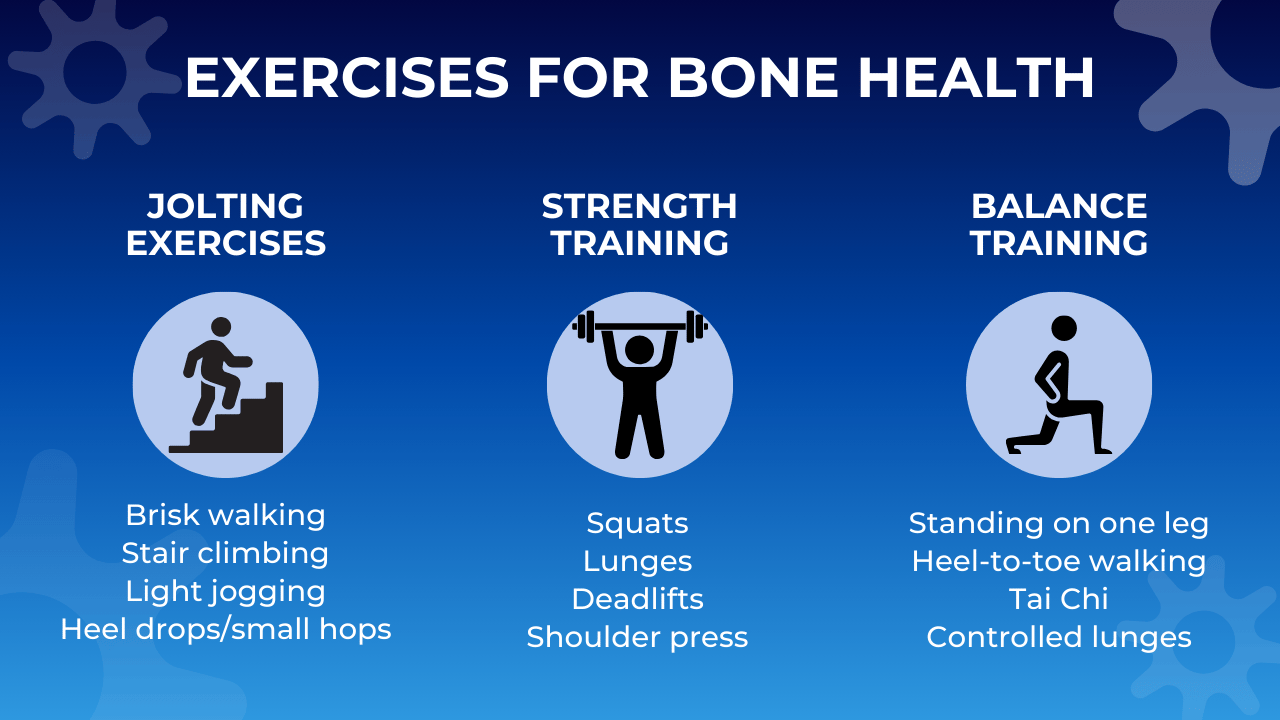
These create small forces through bone that stimulate bone formation. Examples include:
🔹 Brisk walking
Starting with short sets, such as 10 to 20 impacts in a row, and building gradually can help the body adapt safely.
Strength exercises apply controlled load through muscle contraction. Examples include:
🔹 SquatsUsing light weights initially and focusing on good technique is important. Exercises should feel challenging but controlled, and supervision can help reduce injury risk.
Balance work reduces the likelihood of falls, which is a key driver of fractures. Examples include:
🔹 Standing on one legThese can be progressed over time, starting with shorter holds and building towards longer durations.
When fracture risk is higher, medication is often part of the plan. The decision to start treatment is usually guided by bone density, clinical risk factors, and tools such as FRAX.
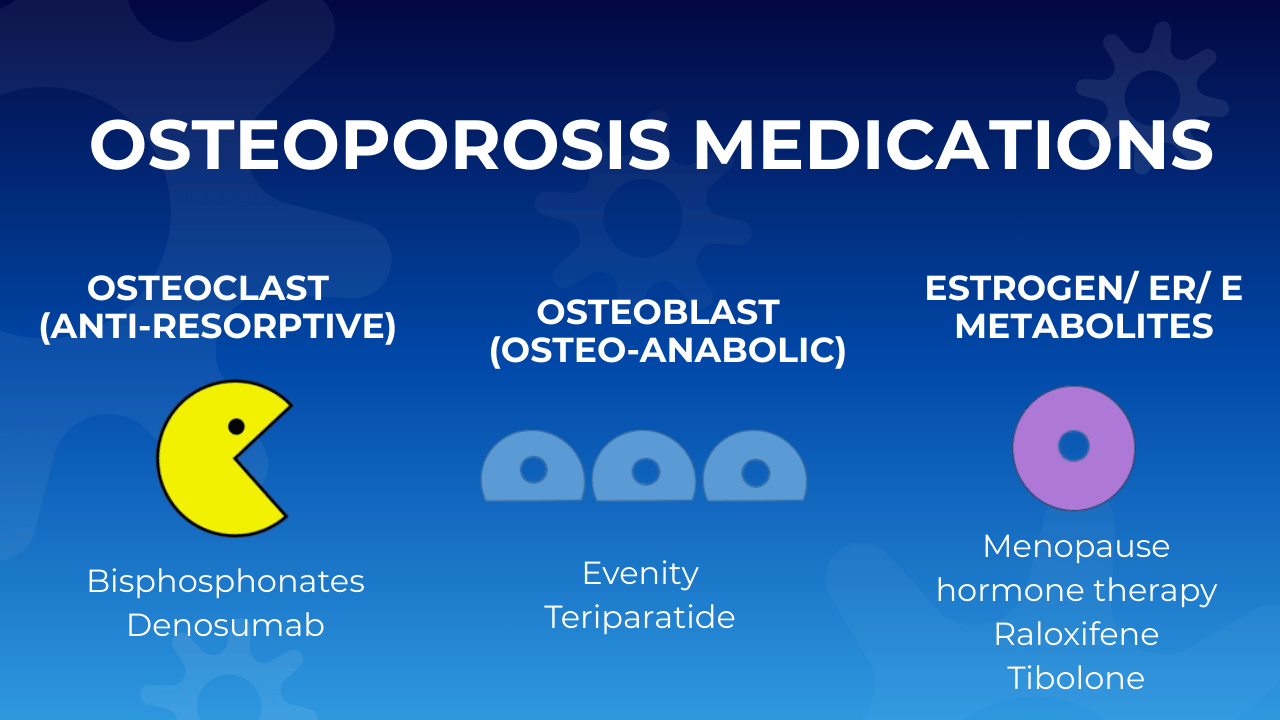
These treatments slow down the rate at which bone is broken down.
🔹 Bisphosphonates includes alendronate and risedronate (oral), and zoledronic acid (intravenous). They are widely used and familiar, often forming the first step in treatment.
🔹 Oral bisphosphonates are taken weekly or monthly and require specific instructions, including taking them on an empty stomach and remaining upright. Reflux can be an issue for some people. These are generally available on the PBS, with relatively low annual costs.
🔹 Zoledronic acid is given once yearly via infusion, which avoids the need for regular tablets. A flu-like reaction for a few days after the infusion is not uncommon. This option is also PBS-listed and relatively low cost.
Rare risks across this group include atypical femur fractures and osteonecrosis of the jaw.
DenosumabThese treatments stimulate new bone formation and are typically used in people at higher fracture risk.
🔹 Romosozumab (Evenity)
This medication has a dual effect, increasing bone formation while also reducing bone breakdown. It is given as monthly injections over a 12 month period.
It is often considered in people with very low bone density or high fracture risk. It cannot be used in individuals with a history of heart attack or stroke. Access may be through the PBS in specific circumstances, such as after a fracture, or privately at a higher cost.
Treatment does not stop after the 12 months. It needs to be followed by an anti-resorptive medication to maintain the improvement in bone density.
🔹 Teriparatide
Teriparatide is another bone-building treatment, taken as a daily injection for up to 18 months. It is generally reserved for higher risk cases, particularly after fractures.
Some people notice mild side effects early on, such as dizziness or nausea, which often settle. PBS access is typically restricted to specific high risk scenarios, with higher private costs if used outside these criteria.
As with romosozumab, follow-up treatment is required to maintain gains.
🔹 Menopause Hormone Therapy (MHT)
This is sometimes used in women around menopause, particularly when osteopenia is present alongside menopausal symptoms. It helps reduce bone loss, though it is not usually first-line purely for osteoporosis.
🔹 Raloxifene
This medication acts on oestrogen receptors and reduces the risk of vertebral fractures. It may be considered in postmenopausal women in selected situations.
🔹 Tibolone
A synthetic hormone with effects on bone as well as menopausal symptoms. Its use depends on individual risk factors, particularly in relation to age and cardiovascular risk.
A man in his early 50s was found to have severe osteoporosis on bone density testing, despite no history of fractures. Contributing factors included reduced calcium intake over many years, avoidance of weight bearing exercise after previous injuries, and a history of smoking and alcohol use.
Based on his overall risk profile, including bone density and clinical factors, treatment was started with romosozumab. At the same time, he began a supervised exercise program that reintroduced weight bearing activity.
Over time, his bone density improved, and he transitioned to maintenance therapy. This reflects a common approach where treatment evolves based on response and ongoing risk.
Referral to an endocrinologist may be helpful in cases of very low bone density, fractures despite treatment, medication intolerance, or when considering anabolic therapies. It can also be useful for reviewing longer term treatment plans, particularly after extended use of medications such as bisphosphonates.
Some medications are associated with rare risks, including osteonecrosis of the jaw and atypical femur fractures. These are uncommon and tend to occur after longer durations of treatment or in specific clinical contexts. Monitoring, dental care, and early reporting of symptoms are important parts of ongoing management.
Osteoporosis is characterised by reduced bone strength and an increased risk of fracture. Assessment includes bone density as well as clinical risk factors, often supported by tools such as FRAX.
Management typically involves adequate calcium intake, appropriate exercise, and medication when fracture risk is elevated. Medications are selected based on individual risk and mechanism of action, and may be PBS-subsidised in specific circumstances.
Ongoing review is important, as treatment plans often change over time depending on response and risk profile.
References:
 This article is based on Endocrinologist Dr Dahlia Davidoff's talk on Osteoporosis Management. You can access the full session and hear their complete insights by watching the full talk here.
.png?width=1280&height=720&name=Sleep%20and%20the%20Anxious%20Brain%20(header).png)