
.png?width=115&height=134&name=Jackzon%20Zhou%20(transparent%20circle).png)

Hypermobility
.png?width=1280&height=720&name=Sorting%20Out%20Your%20Sore%20Shoulder%20(banner).png)

Do you sometimes notice your shoulder getting sore when you take off your jumper, reach overhead or lie on one side? Maybe certain movements have become uncomfortable, or you have found yourself avoiding things you would normally do without thinking. There are a number of different causes of shoulder pain, so understanding what may be contributing to your symptoms can help you work out what to do next.
A lot of people I see with shoulder pain assume there must be one damaged structure responsible for everything they are feeling. That makes sense when pain feels like it is coming from one very specific spot. The shoulder, however, is more complicated than that.
The shoulder is a highly mobile ball-and-socket joint. That mobility allows your arm to move in many different directions, but the shoulder also needs to remain stable while you do it. A number of structures contribute to that stability, including the muscles of the rotator cuff, ligaments, the labrum and the joint capsule. The biceps tendon and the shoulder blade and its surrounding muscles also play a role.
The rotator cuff itself is a group of four muscles: the supraspinatus, infraspinatus, teres minor and subscapularis. One of their primary roles is to help stabilise the shoulder.
This complexity is why two people can have pain doing the same movement but have very different underlying problems. Lifting your arm, for example, can be painful for several different reasons. The location and behaviour of your pain can provide useful clues, but they do not tell the whole story.
It is common to hear someone describe their problem simply as a "sore shoulder", even though shoulder pain is not one single condition. Working out what is contributing to your symptoms starts with looking at the pattern rather than just the location of the pain.
Rotator cuff related shoulder pain may develop gradually and can involve pain when reaching overhead, lifting the arm, lying on the affected side or reaching behind your back. Treatment can include modifying activities that aggravate the shoulder, restoring movement and gradually strengthening the shoulder.
Shoulder bursitis involves irritation of a bursa, a small fluid-filled sac that helps tissues glide smoothly and cushions structures in the body. It can cause pain when lifting the arm, reaching overhead or lying on the affected side, and it can be quite irritable. Bursitis can also overlap with rotator cuff related shoulder pain.
Frozen shoulder tends to involve both significant pain and stiffness. You may particularly notice restrictions when reaching overhead, reaching behind your back, putting on clothes or sleeping. Frozen shoulder typically progresses through three phases: freezing, frozen and thawing, with movement restricted in multiple directions.
Other possibilities include shoulder arthritis, AC joint pain and pain related to the neck.

It's easy to focus on the place that hurts and assume that must be where the problem starts. Sometimes, though, the shoulder is not the whole story.
Pain around the shoulder can have other sources, including the cervical spine in your neck, the thoracic spine in your mid-upper back, nerve irritation, the AC joint or referred pain from another area.
The pattern of your symptoms can provide some useful clues. Neck-related pain, for example, may occur alongside neck pain, tingling or numbness, or symptoms that radiate into the arm. AC joint pain can be felt on the top of the shoulder and may be noticeable during cross-body movements.
Shoulder arthritis can involve stiffness and pain with movement, while lifting and pressing actions may also be uncomfortable.
The key point is that where you feel pain does not necessarily tell you exactly what is causing it. That is one reason an assessment needs to look beyond the painful spot and consider how the different parts of the shoulder and surrounding areas are working together.
When your shoulder hurts, it is understandable to wonder whether you need imaging to find out what is wrong. The idea of seeing something on a scan can feel reassuring because it seems like it should provide a definite answer.
A physiotherapy assessment starts somewhere different. Rather than relying on an image alone, the clinician can first listen to what happened, understand what makes your symptoms better or worse, and ask what activities you are currently unable to do.
They can then assess your movement, strength, function and the possible source of your pain. From there, the aim is to explain what may be happening and develop a plan for moving forwards.
That does not mean imaging is never relevant. It means a scan is not automatically the starting point for every sore shoulder. The assessment helps determine what information is actually needed.
Many people feel unsure about what will happen at their first appointment, particularly when their shoulder has been painful for a while. You do not need to arrive knowing exactly what is wrong.
The first part of an assessment is about listening. Your physiotherapist will want to understand what happened, what makes your symptoms better or worse, and what you are finding difficult to do.
The physical assessment then looks at things such as:
From there, your physiotherapist can explain the problem and work with you on a plan.
This is also where treatment can be tailored to what your shoulder actually needs. Manual therapy may be used for pain relief and to help restore range of movement, while activity modification, movement and gradually building strength can form part of the longer-term plan.
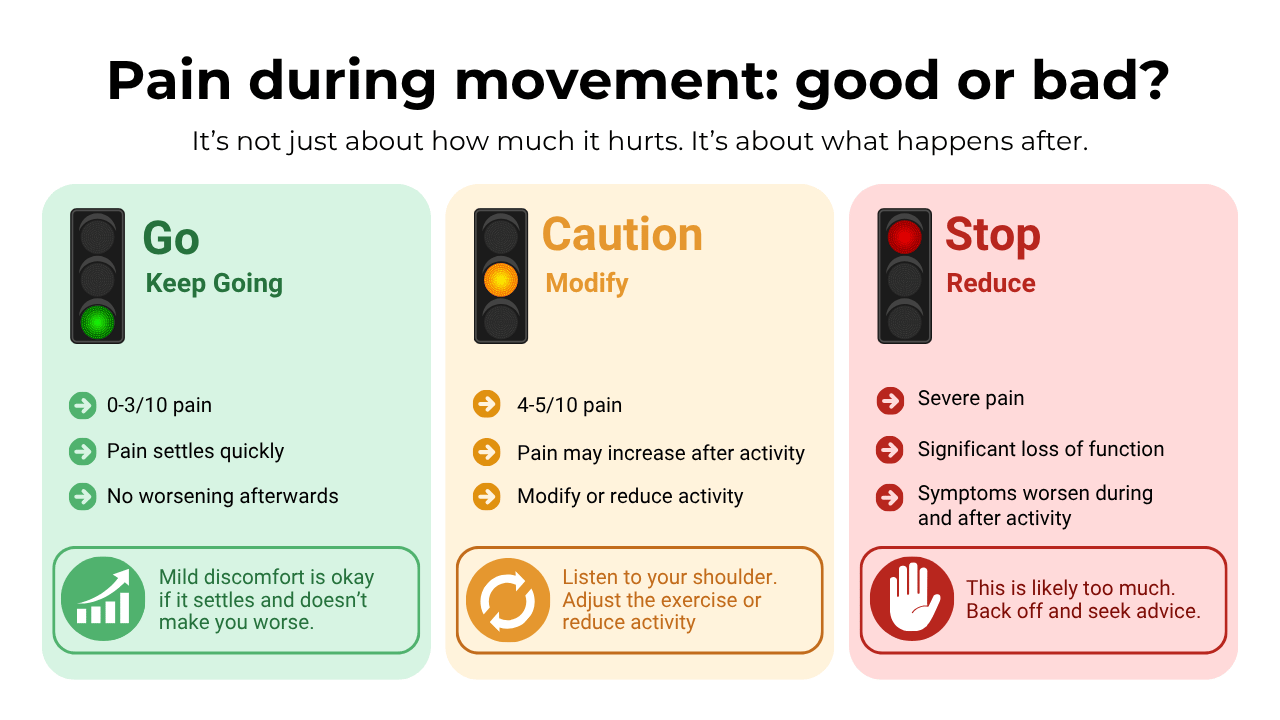
When a movement hurts, your first instinct may be to avoid using the shoulder altogether. That can feel like the safest option, especially when you are worried that pain means you are causing more damage.
But complete rest is not always necessary. The approach outlined in the session is to keep moving while modifying the activities that flare your symptoms.
That might mean reducing or changing a particular movement rather than stopping everything. As symptoms settle, strengthening can then be built up gradually over time.
The distinction matters: pain and damage are not the same thing. Pain is a useful part of understanding what your body is experiencing, but pain alone does not tell you exactly what has happened to a structure.
For some people, the process can take time. There is no single timeline that applies to every type of shoulder pain, because the underlying problem, symptoms and response to treatment can differ.
If you are unsure about what movements are appropriate for you, this is a good point to seek individual guidance rather than guessing or avoiding activity altogether.
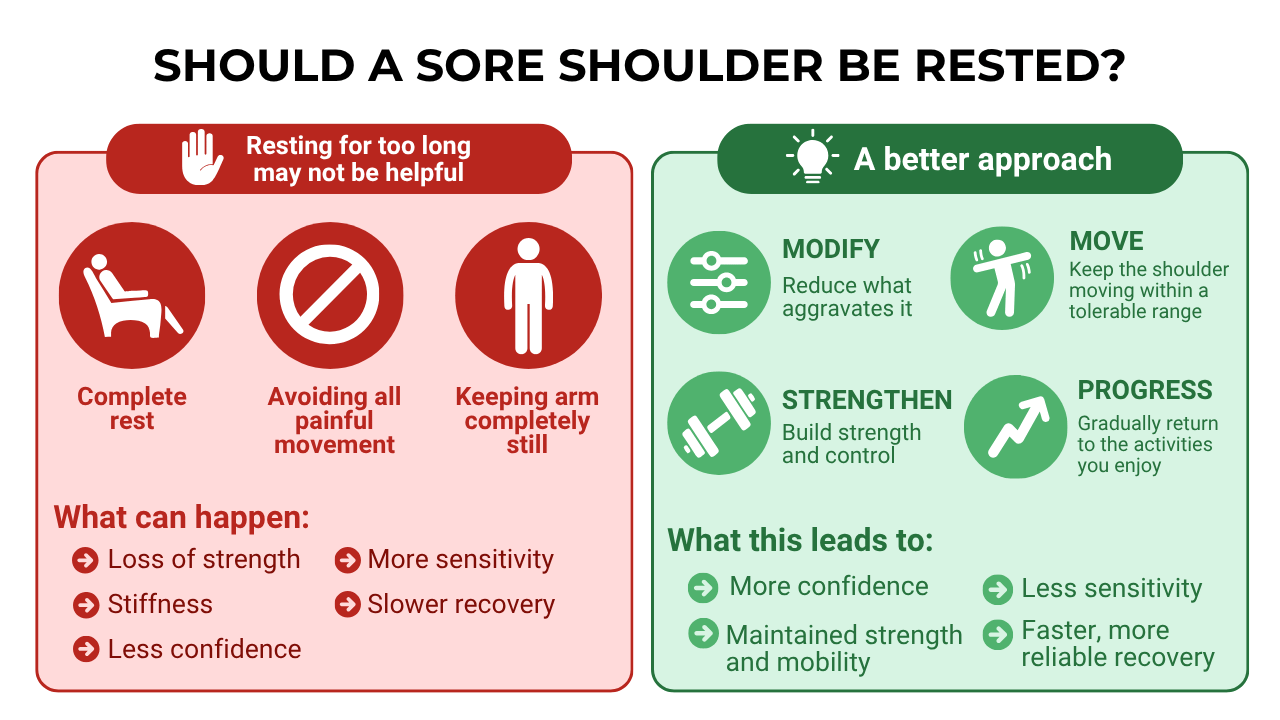
A painful shoulder can leave you second-guessing everyday movements, particularly when you are not sure what is causing the problem. The good news is that you do not need to work that out on your own.
Understanding the possible source of your pain, keeping movement where appropriate, modifying activities that aggravate it and gradually rebuilding strength can all form part of the plan. A physiotherapist can help you work out where to start and how to move forwards safely and practically.
If you are living with shoulder pain, the goal is not simply to stop doing everything that hurts. It is to understand your shoulder and find a way to keep moving while gradually building your capacity.

This article is based on Jackson Zhou's talk on Sorting out your Sore Shoulder held on 5 August 2026.
.png?width=1280&height=720&name=Sleep%20and%20the%20Anxious%20Brain%20(header).png)