
.png?width=115&height=134&name=Esha%20Shetty%20(transparent%20circle).png)

Hypermobility
.png?width=1280&height=720&name=Control%20Starts%20Here%20Understanding%20Your%20Pelvic%20Floor%20and%20Bladder%20(header).png)

Have you ever changed your exercise, travel plans or daily routine because of bladder concerns? Perhaps you leak a little when you cough, sneeze, laugh or exercise. Maybe you have experienced a sudden, strong urge to go and worried you would not make it to the toilet in time. Or perhaps you find yourself planning your day around knowing where the nearest bathroom is.
These experiences are more common than you might think. They are also not something you simply have to put up with. Understanding your pelvic floor health can be a useful first step towards understanding what might be contributing to your symptoms and what support could help.
It can be easy to think of your pelvic floor as something you only need to think about when there is a bladder or bowel problem. In reality, these muscles are working throughout the day, usually without you noticing.
Your pelvic floor is a group of muscles that forms a sling at the base of your pelvis. It stretches from the pubic bone at the front towards the tailbone at the back, supporting the bladder, bowel and, in women, the uterus from below. It plays an important role in bladder and bowel control, while also working alongside your deep abdominal muscles, diaphragm and back muscles to contribute to core stability.
You rely on these muscles during ordinary movements. For example, your pelvic floor responds when you:
This is why pelvic floor health is not only about treating leakage or other bladder symptoms. These muscles need to be able to respond to changes in pressure, support your pelvis and work together with the rest of your core as you move through everyday activities.
Bladder symptoms can look different from person to person. You might notice:
It is common to feel as though these symptoms are simply part of getting older, having children or becoming less active. But common does not mean that you have to live with them, and bladder symptoms can be treated.
There are several factors that may be associated with bladder symptoms, including:
Another common misunderstanding is that every pelvic floor problem is caused by weakness. An under-active pelvic floor can involve muscles that are weak or slow to respond, but an over-active pelvic floor can involve muscles that are tight or unable to fully relax. This can be associated with pain, urgency or difficulty fully emptying.
That is why simply doing more pelvic floor exercises is not necessarily the right approach for everyone. Sometimes the muscles need to become stronger. Sometimes they need to learn how to relax.
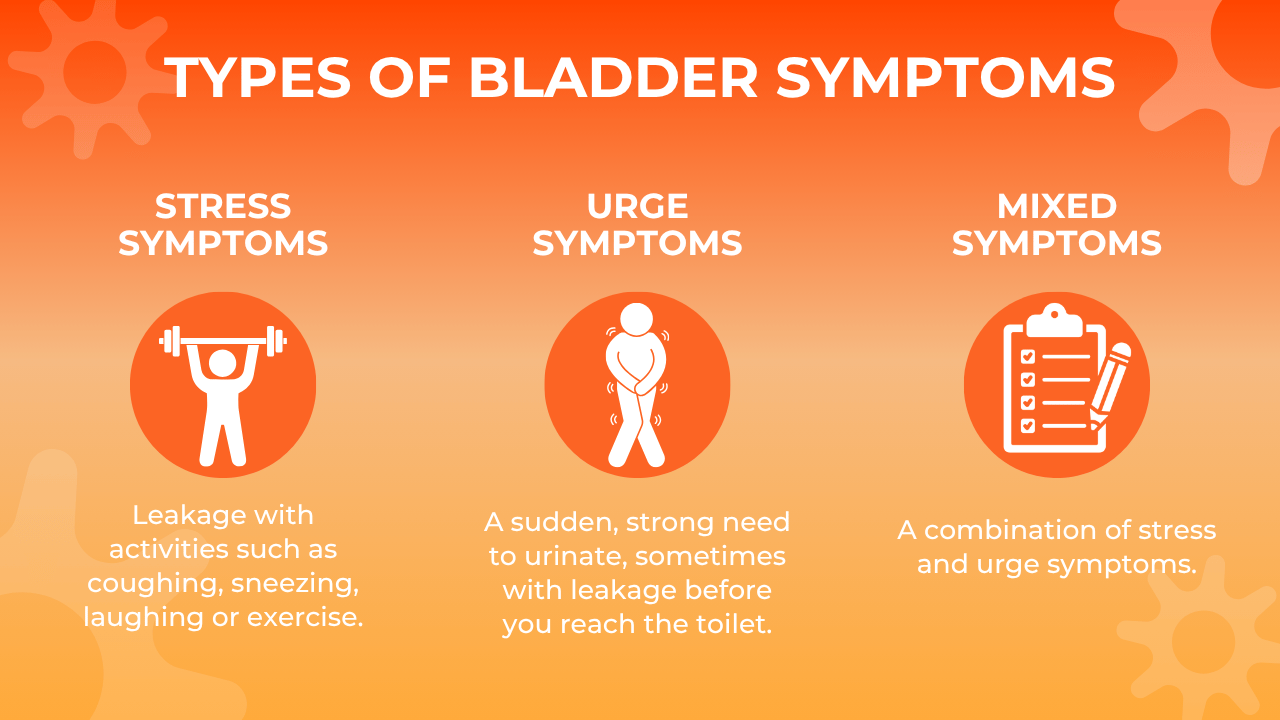
Stress symptoms involve leakage with activities such as coughing, sneezing, laughing or exercise.
Urge symptoms involve a sudden, strong need to urinate, sometimes with leakage before you reach the toilet.
Mixed symptoms involve a combination of stress and urge symptoms.
Another common misunderstanding is that every pelvic floor problem is caused by weakness. An under-active pelvic floor can involve muscles that are weak or slow to respond, but an over-active pelvic floor can involve muscles that are tight or unable to fully relax. This can be associated with pain, urgency or difficulty fully emptying.
That is why simply doing more pelvic floor exercises is not necessarily the right approach for everyone.
A lot of people know they are supposed to do pelvic floor exercises but are unsure whether they are actually using the right muscles. Technique comes first. The aim is not to squeeze as hard as possible.
Start somewhere comfortable, such as sitting or lying down. Relax your jaw and shoulders and breathe normally.
You can use the sensation of gently drawing upwards around the back passage as a cue, or imagine stopping the flow of urine. Then gently lift and squeeze without holding your breath.
As you practise, check that:
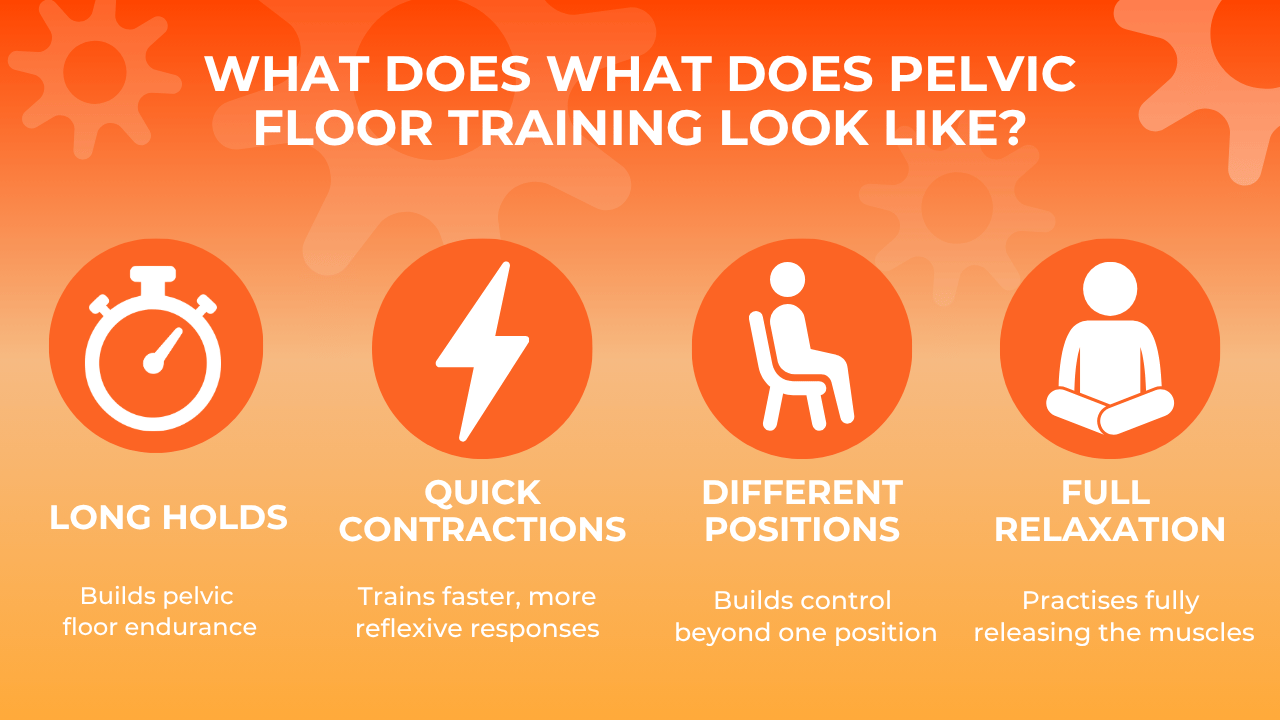
That release matters. Pelvic floor training is not simply about making the muscles stronger. The muscles also need to be able to relax fully.
It can be useful to work on both longer holds and quick contractions. As a starting point:
This is a starting point rather than a prescription, and an individual plan may look different.
Sometimes the changes that matter most are not another exercise session, but the habits surrounding your bladder.
It can be tempting to restrict fluids because you are worried about leaking. Having enough fluid spaced throughout the day, rather than drinking excessively or restricting fluids out of fear, can help support healthy bladder habits. It can also be useful to avoid regularly going to the toilet "just in case", as this can encourage the bladder to signal urgency earlier.
When you do go, try not to rush or strain. Give yourself enough time for relaxed, complete emptying.
It can also be useful to become aware of potential bladder irritants rather than automatically cutting everything out. These include:
The focus is on awareness rather than automatically eliminating these drinks.
During exercise, pelvic floor engagement may be useful during higher-impact activities. Breathing out during effort, such as when lifting or standing up, can also help you avoid holding your breath.
If you are not sure what might be contributing to your symptoms, a bladder diary can give you something more useful than guesswork.
Over two to three days, you can record:
This can help identify patterns in your day-to-day habits and provide useful information to discuss with your physiotherapist.
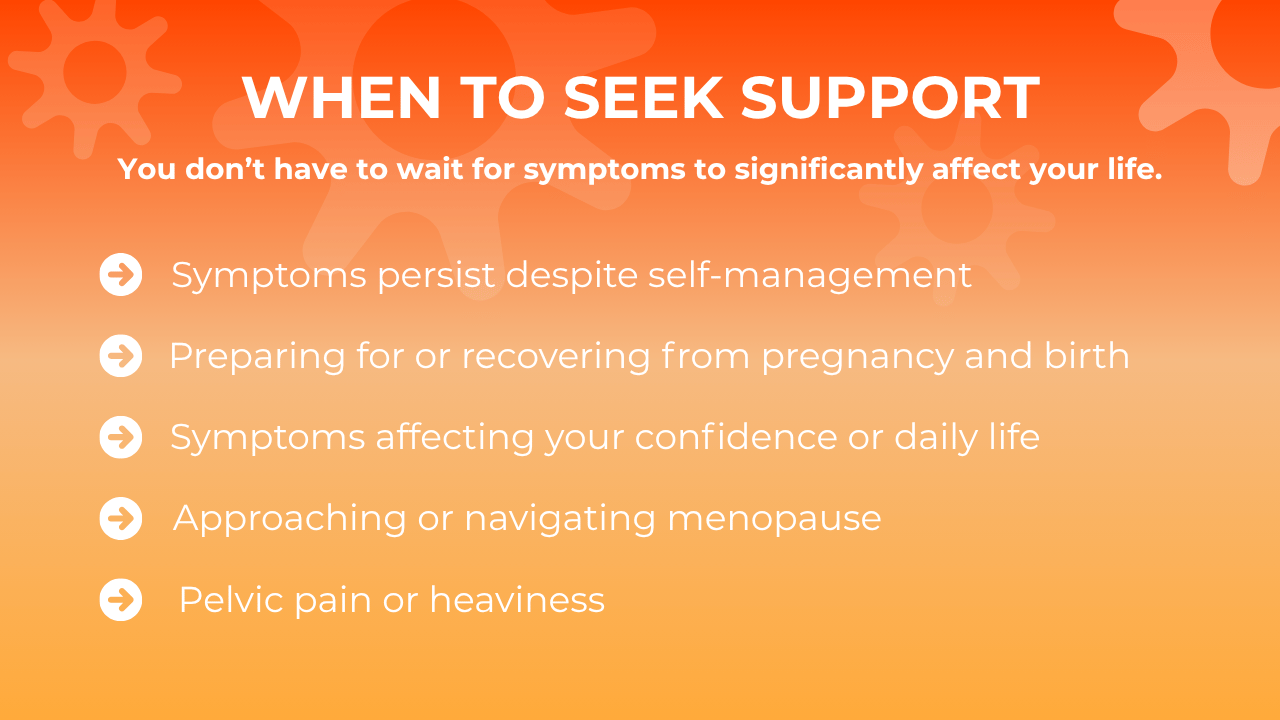
You do not need to wait until bladder or pelvic floor symptoms are severely affecting your life before talking to someone. It may be worth seeking support if:
I often find that people feel unsure about what a pelvic floor assessment will involve. The first appointment starts with a conversation about your history, symptoms and goals, at your pace.
An assessment may include an external and/or internal assessment, but this is always done with your consent and explanation.
From there, your physiotherapist can develop practical strategies and exercises based on your individual needs, rather than giving you a generic list of exercises. Follow-up appointments can then be used to adjust the plan as you progress.
This is also where multidisciplinary care can be useful. Depending on your symptoms and goals, your physiotherapist can work alongside other members of your healthcare team when additional support is needed.
Your pelvic floor is trainable at any age and stage of life, and bladder or pelvic floor symptoms are not something you simply have to accept.
Start by paying attention to what your body is telling you. Small, consistent changes are more useful than occasional bursts of effort, and getting the right assessment can help you understand whether your pelvic floor needs strengthening, relaxation, or a combination of both.
You do not need to have everything figured out before asking for help. Sometimes the first step is simply starting the conversation.

This article is based on Esha Shetty's talk on "Control Starts Here: Understanding Your Pelvic Floor & Bladder Health". You can watch the full session and hear her complete insights by watching the full talk here.
.png?width=1280&height=720&name=Sleep%20and%20the%20Anxious%20Brain%20(header).png)